PRODUCT-SPECIFIC TESTINGDifferent products require different test priorities
Confirm the polymer, product structure, intended function and project specification before defining applicable tests and acceptance criteria.
01Geomembranes | identify the polymer system first
Routine focus: Polyethylene geomembranes commonly require thickness, density, tensile yield and break properties, tear resistance, puncture resistance, carbon-black content and dispersion, and oxidative induction time; textured products may also require asperity height.
Boundary: Other resins and composite geomembranes require test programmes appropriate to their material and structure; an HDPE or LLDPE list must not be copied without review.
02Geotextiles | distinguish structure and function
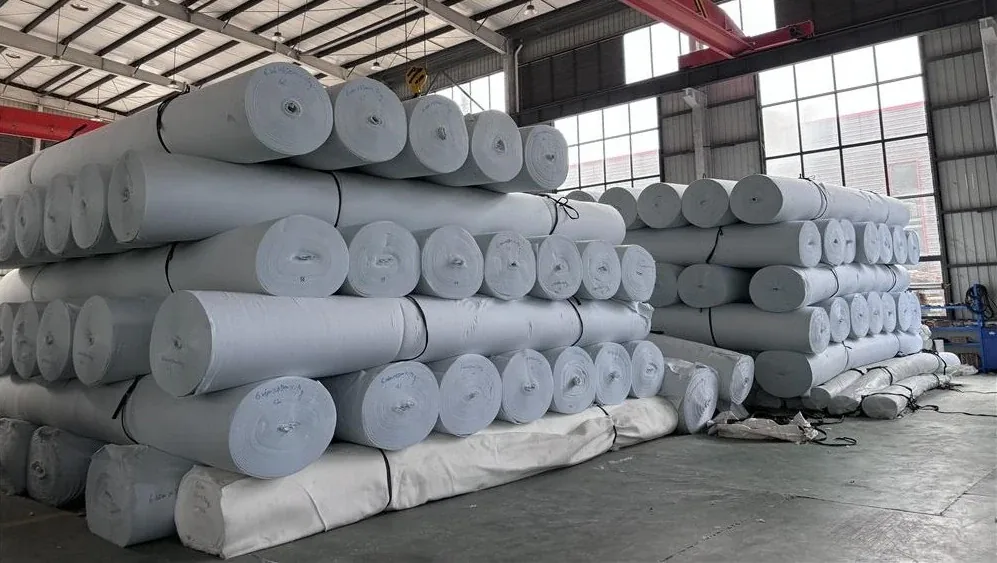
Routine focus: Mass per unit area, thickness, wide-width tensile and elongation, puncture or CBR puncture, characteristic/apparent opening size and water permeability are common considerations.
Boundary: Woven and nonwoven products, and filtration, separation, protection or reinforcement functions, do not share one universal acceptance table.
03Geogrids | separate short- and long-term behaviour
Routine focus: Geometry, ultimate tensile strength, strength at specified strain and elongation are common lot tests; junction or connection properties apply only to relevant structures.
Boundary: Long-term design strength, creep and reduction factors for installation damage and durability are product-system and design-verification data, not routine release tests for every lot.
04Geocells | control both strip and connection
Routine focus: Strip thickness and dimensions, weld spacing or cell size, strip tensile properties, weld peel or connection strength and finished-panel appearance.
Boundary: Connection-test method and acceptance must correspond to polymer system, product standard and intended use; one tensile value does not define system performance.
05Geobags & geotextile tubes | distinguish finished structures
Routine focus: Base-fabric mass per unit area, wide-width tensile and elongation, seam strength, opening size, hydraulic properties and finished dimensions.
Boundary: Geotextile tubes also require review of filling ports, circumference, length and seam arrangement; bag and tube inspection requirements are not interchangeable.
06Geosynthetic clay liners | materials and hydraulic behaviour
Routine focus: Finished-product and bentonite mass per unit area, moisture content, swell index or fluid loss, peel strength, tensile strength and index flux or hydraulic conductivity.
Boundary: Hydraulic results depend on specimen conditioning, permeant and normal stress; comparisons are valid only when the test method and conditions are also reviewed.
07Drainage geocomposites | test the assembled structure
Routine focus: Thickness, mass per unit area, tensile properties, ply adhesion or peel, compression response and in-plane flow capacity according to product structure.
Boundary: In-plane flow capacity depends on normal stress, hydraulic gradient and boundary conditions, so technical values must be interpreted together with test conditions.
A test list is not a fixed template. First confirm the applicable standard revision, technical data sheet and contract; then define lot, sampling, method, frequency and acceptance. Typical values, minimum average roll values (MARV) and individual minimum or maximum values must not be mixed. Routine factory testing, project conformance testing and third-party verification should remain separately identified.